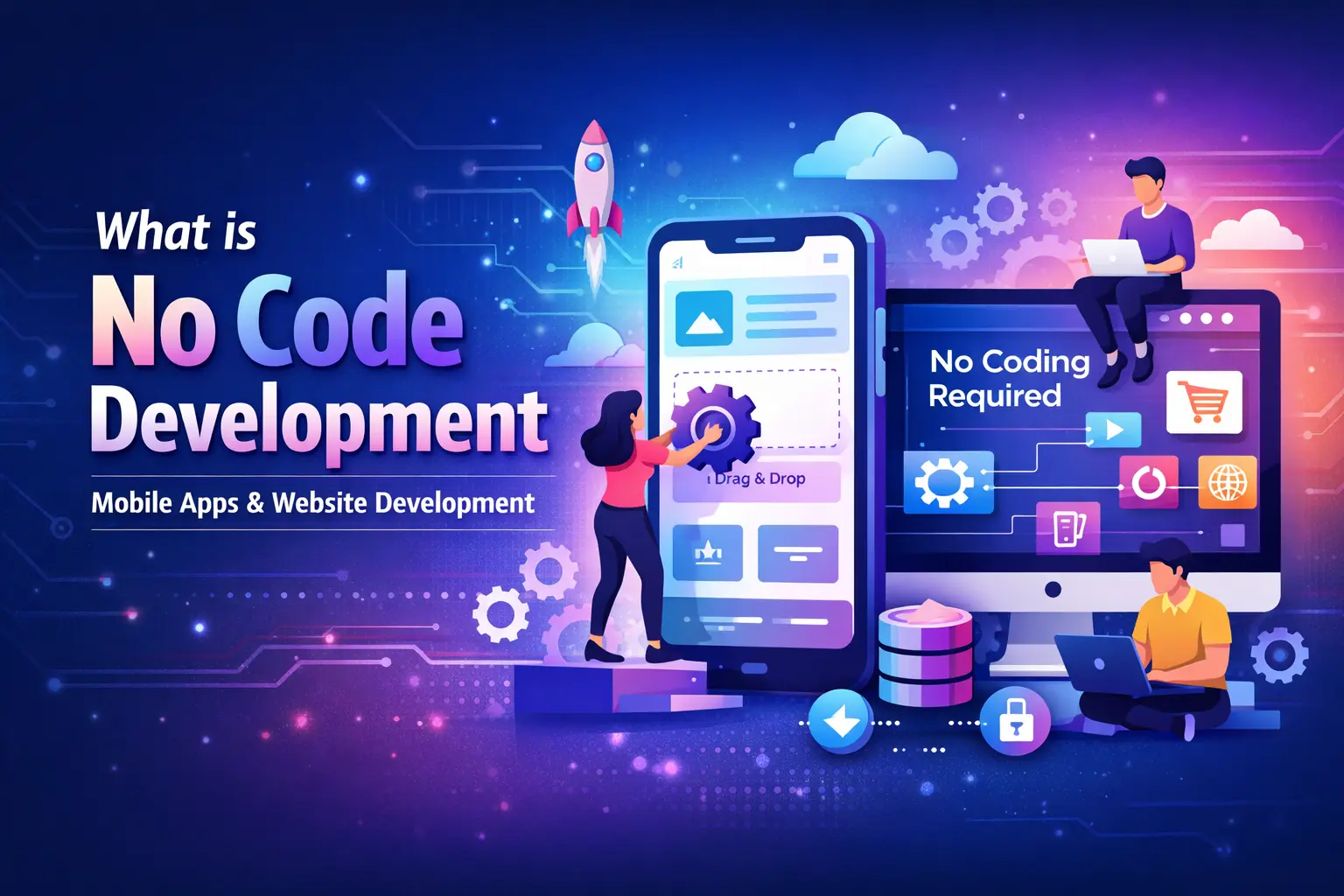

Digital products no longer belong only to traditional developers. Over the last few years, no code development has transformed how businesses build mobile apps and websites making it possible to launch functional, scalable platforms without writing complex code.
But what exactly is no code development? Is it reliable? Can it scale? And when should you choose it over traditional development?
This guide answers those questions in depth so you can decide whether no code is the right approach for your mobile app or website project.
What is No Code Development?
No code development is a software development approach that allows users to build websites, web applications, and mobile apps using visual interfaces instead of traditional programming languages like JavaScript, Python, or Swift.
Instead of writing code manually, users:
- Drag and drop elements
- Configure workflows visually
- Connect databases through built-in integrations
- Automate processes using logic builders
The platform generates the underlying code automatically.
In simple terms, no code platforms convert your design and logic into working software without requiring you to type lines of code.
Why No Code Development is Growing So Fast
The demand for faster digital transformation has pushed businesses to look for smarter alternatives to traditional development. No code tools meet that demand because they:
- Reduce development time dramatically
- Lower initial costs
- Remove dependency on large engineering teams
- Allow faster testing and iteration
For startups and small to mid-sized businesses, this means launching a minimum viable product (MVP) in weeks instead of months.
For enterprises, it enables internal teams to build operational tools without waiting for development backlogs.
How No Code Development Works
At its core, no code development is built around three key layers:
1. Visual Interface Builder
This is where you design your website or mobile app. You arrange UI components such as buttons, forms, images, and text blocks visually.
2. Logic & Workflow Automation
Instead of writing conditional statements, you define rules visually:
- If a user submits a form → send email
- If payment is successful → grant access
- If user signs up → store data in database
3. Database & Integrations
Modern no code platforms include built-in databases and connect easily with tools like payment gateways, CRMs, marketing automation systems, and analytics platforms.
The result is a fully functional application without manual backend coding.
No Code vs Traditional Development: What’s the Difference?
The main difference lies in control and flexibility.
Traditional development offers complete customization and is ideal for complex, highly scalable systems. However, it requires skilled developers, longer timelines, and higher budgets.
No code development, on the other hand, is ideal when:
- You need to validate an idea quickly
- Your app logic is not extremely complex
- You want faster deployment
- Budget constraints exist
It is not a replacement for coding in every scenario but it is a powerful solution for many business cases.
Types of Projects You Can Build with No Code
Modern no code platforms are far more capable than basic website builders. Today, you can build:
Business Websites
Corporate websites, landing pages, portfolios, and service sites with dynamic content and SEO capabilities.
E-commerce Stores
Online stores with payment integration, inventory management, and automation.
Web Applications
Membership portals, dashboards, booking systems, CRM tools, and SaaS platforms.
Mobile Apps
Cross-platform mobile apps for Android and iOS with user authentication, push notifications, and API integrations.
The technology has matured significantly making it suitable for real-world commercial applications.
Is No Code Development SEO-Friendly?
One of the most common concerns is whether no code websites rank on Google.
The answer is yes-if implemented correctly.
Modern no code platforms provide:
- Custom meta titles and description
- Structured URLs
- Schema markup options
- Fast hosting infrastructure
- Mobile responsivenes
- SSL security
SEO performance depends more on content quality, site structure, and optimization strategy than on whether the site was built with code or no code.
From Google’s perspective, what matters most is:
- Page speed
- User experience
- Content relevance
- Technical optimization
If these factors are handled properly, no code websites can rank competitively.
Advantages of No Code Development
Faster Time to Market
You can go from concept to live product in weeks instead of months.
Lower Development Cost
You eliminate the need for a full development team in early stages.
Easy Updates & Maintenance
Changes can be made quickly without deep technical knowledge.
Rapid Experimentation
Ideal for A/B testing, MVP validation, and iterative product improvement.
Limitations You Should Know
An expert perspective also requires transparency.
No code development may not be suitable for:
- Highly complex enterprise software
- Deeply customized backend architecture
- Performance-heavy real-time systems
- Extremely large-scale infrastructure needs
Additionally, you rely on the platform’s ecosystem. Vendor lock-in can be a consideration, so choosing the right platform is critical.
Is No Code Development Secure?
Security depends on the platform you choose.
Reputable no code platforms offer:
- Secure hosting
- Data encryption
- Role-based access controls
- Compliance frameworks
However, businesses handling sensitive financial or healthcare data should carefully evaluate compliance requirements before deployment.
When Should You Choose No Code?
No code development is a strategic choice when:
- You are launching a startup and need speed
- You want to validate an idea before full investment
- Your budget is limited
- You want internal teams to build tools independent
- You need a functional product quickly
It is not about avoiding developers, it is about using resources intelligently.
The Future of No Code in Mobile & Web Development
The no code movement is not a trend, it is a structural shift in how digital products are built.
As AI integration increases, no code platforms are becoming even more powerful, enabling:
- Automated UI generation
- Smart workflow creation
- AI-assisted content structuring
- Predictive analytics integration
The gap between traditional and no code development continues to shrink.
Final Thoughts: Is No Code Right for You?
No code development democratizes innovation. It empowers founders, marketers, and business owners to turn ideas into working digital products without heavy technical barriers.
However, the right decision depends on:
- Your business goals
- Product complexity
- Scalability needs
- Budget and timeline
If your goal is to build a professional website or mobile app quickly, validate an idea, or streamline operations, no code development can be a powerful and strategic solution.
The key is not whether you use code or no code. The key is building something valuable, usable, scalable and aligned with real user needs.
By: A Tech Sight